

Funded projects
Thanks to funding from the EU, as well as from federal and state sources, we are able to invest in targeted research and development, and in cutting-edge new technologies. This allows us to drive innovation, explore new areas of application and continuously refine our solutions. These funded projects also aim to generate sustainable benefits for the general public and provide insights for future research topics.
For us, this means greater flexibility and the ability to efficiently implement challenging projects. Our customers benefit from forward-looking technologies, optimized processes and cost-effective, cutting-edge solutions.

Ensuring the long-term safety, modernization and monitoring of railway infrastructure is essential for achieving sustainable, resilient and safe mobility in Germany and Europe. The project's overarching goal is to develop innovative, cost-effective monitoring systems for bridges and track structures, enabling continuous and precise condition monitoring via modern sensor technology and intelligent data processing.
The Saxon partners are focusing on developing and optimizing an imaging radar system for non-contact detection of movements and deformations on bridges and track systems. The goal is to achieve measurement accuracy in the sub-millimeter range with simple installation. SPEKTRA is responsible for characterizing the sensor technology in controlled conditions and supporting the optimization of measurement methods for static and dynamic structural properties.
A key priority of the project is ensuring the commercial viability of the solutions developed. Following successful demonstration and any necessary further development, the partners aim to transition the technologies to commercial use. Close collaboration with industry and targeted outreach to potential users is creating the conditions to establish the developed systems in the market sustainably. In this way, the project is making an important contribution to innovation leadership in infrastructure monitoring and supporting the long-term safety and availability of rail infrastructure in Germany and beyond.
Funding period: January 1, 2026 – December 31, 2027

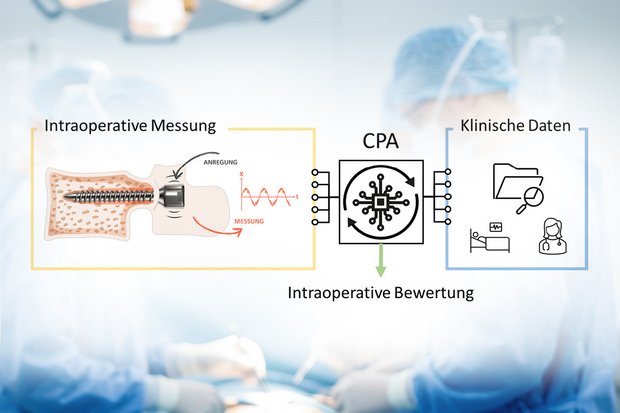
Providing standard care and assessing the secure anchoring of implants in bone is becoming increasingly difficult in spinal surgery. The aim is to develop a device that uses vibration diagnostics to assess the primary stability of spinal implants during surgery. To achieve this, the instrument induces vibration in the implant screw. Analysis of the resulting vibration behavior allows conclusions to be drawn about the mechanical connection to the bone.
The CPA (Coupled Process Analysis) method, derived from production engineering, links measurement data with preoperative patient data. It can identify relevant process parameters using a small number of data sets and derive appropriate recommendations for action or compensation. Initially, the adaptive CPA system uses pre- and intraoperative data to perform a data-driven assessment during surgery and predict the impact of necessary adjustments, such as using an alternative screw size or applying additional cementation. Further linking this data with postoperative data will eventually enable the success of the treatment to be predicted, in addition to the intraoperative assessment of primary stability, allowing the physician to adjust their decisions accordingly as needed.
Funding period: December 1, 2025 – November 30, 2028
Acoustic Emission (AE) testing is one of the most promising methods for structural health monitoring (SHM). AE testing is also widely used in laboratory-based materials testing. However, when it comes to condition monitoring and predictive maintenance of machinery such as gearboxes, bearings, machine tools, pumps and turbines, the transition from laboratory to practical application has not yet been convincingly demonstrated.
The theoretically possible frequency range of these signals is specified as approximately 1 kHz to 100 MHz. AE signals are acquired using measurement chains consisting of a sensor, amplifier, filter and digital measurement cards (i.e. platform technology). In practice, measurement chains for acquiring AE signals with a frequency bandwidth ranging from approximately 10 kHz to 2 MHz are widely used and commercially available. However, a measurement chain based on platform technology that can acquire broadband AE signals up to 10 MHz and meets the aforementioned requirements is not yet available.
In this project, a phased-array platform will be used as a vibration exciter instead of the conventional transfer block. This allows for the precise simulation of a horizontally propagating wave through parallel and phase-delayed vertical excitations.
The project's results are expected to improve the quality of AE testing procedures. Those who will benefit immediately from the results include laboratories performing AE calibrations, manufacturers of AE sensors, amplifiers and measurement cards, calibrators and manufacturers as well as users of testing machines for destructive materials testing. The results will also benefit, albeit indirectly, manufacturers and operators of machines and equipment in industrial settings who wish to use AE testing methods for diagnosis or monitoring or AE signals for machine control and regulation.
Funding period: October 1, 2025 – March 31, 2028
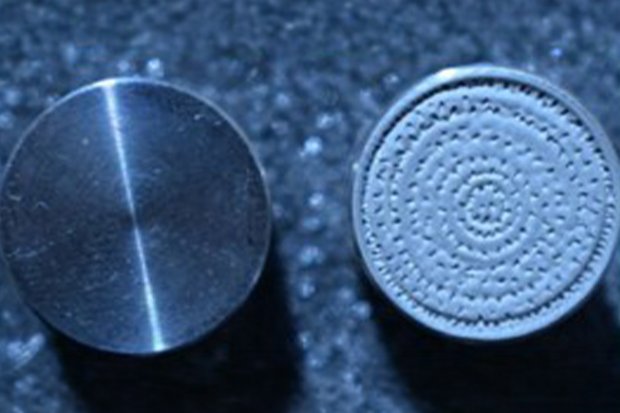

After a thorough analysis of the current system landscape, requirements are precisely defined. Based on this, a technical and functional concept is developed to ensure the integration of existing systems. This is followed by the phased implementation of the SPEKTRA HUB, beginning with core areas such as data management, user management, and document management. At the same time, an intuitive user interface is developed to simplify operation and make workflows more efficient. Following technical implementation, the system is rolled out across the entire company. A key focus is on training employees to ensure seamless integration and high levels of acceptance. After the rollout, the operation of the SPEKTRA HUB is regularly evaluated to identify and implement potential improvements at an early stage.
Funding period: February 3, 2025 – February 28, 2026

In SysDamp, the vibration behavior of wind turbines is examined in great detail. Various experimental and numerical methods are employed to determine damping parameters from field measurements, which are then incorporated into the design process for new turbines. The ultimate goal is to develop a strategy for future wind turbine prototypes.
- Generation of measurement data using sensors already installed on a wind turbine at the WiValdi research wind farm to determine the modal damping of the entire system.
- Development of a multi-shaker inertial excitation system for the targeted excitation of vibration-relevant modes originating from the nacelle area of the wind turbine.
- Generation of measurement data using existing sensors on an operational wind turbine under specifically controlled operating modes, some of which are also off-design.
- Development of methods to determine the damping values of the tower and blade modes of the entire wind turbine from measurement data using accelerated, fully automated approximation algorithms in the time and frequency domains, with the goal of being able to track more than 15 modes.
- Model and result validation of the aeroelastic simulation of the wind turbine is performed using the damping parameters identified from the field test; component (section) loads in various load cases are compared with the test data, and a comparison is made with conventional models.
- Automated calibration of damping between measurements and simulations to improve model quality and prediction accuracy.
- Determination of the influence of uncertain damping parameters using sensitivity analysis.
Funding period: January 1, 2024 – December 31, 2026
Read more about the project in this article.

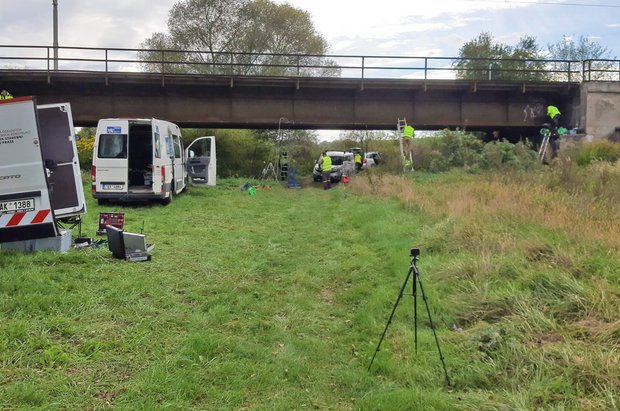
SRIMS is a major German-Czech project being carried out in collaboration with Statotest, the Faculty of Civil Engineering at the Czech Technical University in Prague (CTU), and partners in Saxony—the Fraunhofer IIS and SPEKTRA Schwingungstechnik und Akustik GmbH Dresden—is being carried out. The goal of this project is to develop a monitoring system for rail transport designed to significantly improve the safety and efficiency of the rail network.
The project focuses on the safety and stability of railway bridges and the associated infrastructure, including rails, track superstructure, track substructure and switches, which are essential for reliable rail operations. The research focuses on the assessment of critical infrastructure, the development and mapping of sensor systems for data acquisition, and numerical modeling for risk analysis and condition prediction. In addition, an expert platform with cloud connectivity is being developed to efficiently evaluate the collected data. Key results include a validated monitoring system that combines specialized sensors with a cloud-based expert system, as well as a test environment for system validation and the development of intelligent algorithms.
Funding period: January 1, 2024 – December 31, 2025
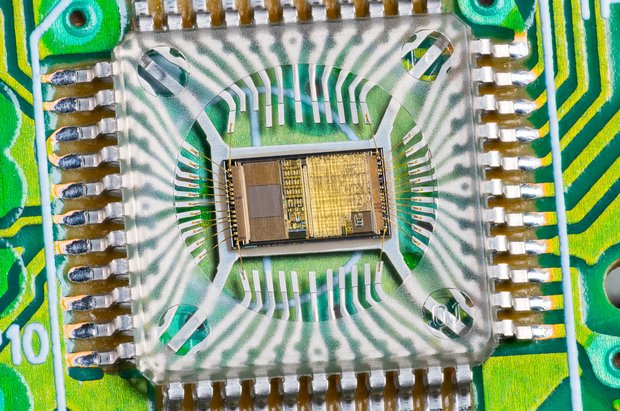
As part of this project, a combined test system is to be developed that cost-effectively incorporates "precise sensor excitation" and "fast, parallel sensor testing", making it suitable for a wide range of MEMS sensors. In order to test the next generation of MEMS sensors with sufficient accuracy and respond flexibly to growing test requirements, new measurement technology is essential.
The measurement hardware must be able to perform many parallel tasks. It must be a modular measurement board that operates autonomously and has sufficient hardware resources to support and test a variable number of test specimens (or groups of test specimens). Current semiconductor test systems are too large to be used effectively in sensor development and too expensive for final measurement.
An optimized test system for highly accurate, cost-effective MEMS sensor testing could fill an economic gap in the test market. Integrating numerous measurement functions onto a single card meets the requirements of the MEMS sensor segment.
Funding period: August 1, 2023 – July 31, 2026
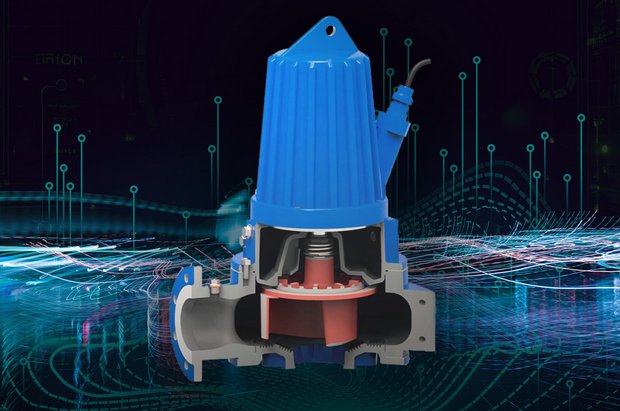
VIPFLUID aims to collect condition data from wastewater pumps using appropriate sensor technology and utilize it for machine learning. Adaptive sensor technology and an intelligent sensor hub will initially collect the pump data and preprocess it locally at the edge to send a compressed data stream to local computing resources (fog). Synthetic data generated through machine learning (ML) will then enable local, resource-efficient, adaptive predictive models.
The developed software solutions are based on generative neural networks and federated learning and are intended to establish the use of machine learning in the field of predictive maintenance in a cost-effective and environmentally friendly manner. This enables proactive maintenance and minimizes reactive measures. This prevents costly and system-critical failures and significantly improves process reliability. The reliable predictive results generated enable a significant reduction in maintenance resources. This technology enables a substantial reduction in CO2 emissions and thus supports the achievement of climate and environmental protection goals.
Funding period: May 1, 2023 – April 30, 2026