


MEMS-sensors have increasingly become an integral part of our world. Importantly, even vital applications such as ADAS (advanced driver-assistance systems), IoT, Industry 4.0 etc. often require highly accurate sensor data. This increases the demand for cost-effective MEMS sensors. Despite a slight decline in growth, the industry is still expecting an annual growth rate of 10% or more. At the same time, the decline in ASP (average sales price), especially in the consumer sector, leads to increased price pressure for sensor manufacturers. The growing degree of integration (e.g. by combined sensors) creates an additional need to reduce the manufacturing costs and thus also the test costs.
The S-TEST System from SPEKTRA is precisely fit for this demand. By concentrating on the clearly defined requirements of a system level test (SLT) of digital sensors, the S-TEST system offers significant functional and cost advantages compared to conventional VLSI test systems.
In the system level test, the sensor is used similar to a final application, while the sensor is stimulated with clearly defined environmental stimuli. For cost-optimized testing of digital MEMS sensors, the SPEKTRA S-TEST platform offers a flexible solution for all common sensor interfaces (I²C, SPI, JTAG, CAN, LIN, PSI5, SENT, ZACwire, …).
The system is scalable and can be used both as a compact desktop device in sensor development as well as in a multiparallel production test of sensors in production. The flexible combination with handling systems from various manufacturers offers additional investment protection.
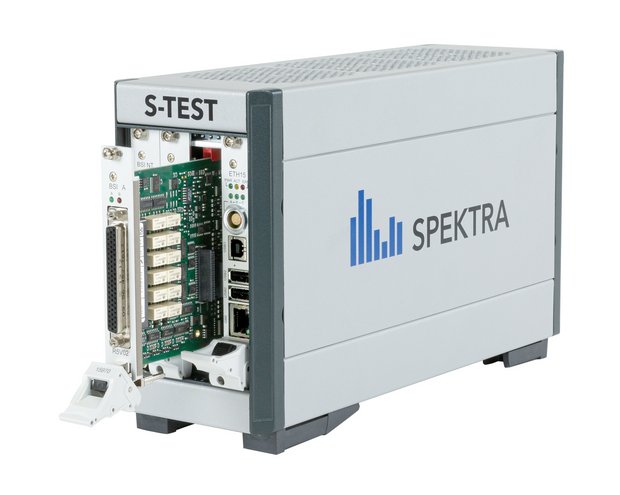
Features:
- Cost-optimized testing for low-cost sensors
- Optimized hardware for System Level Test
- Available standard interfaces, e.g. I²C, SPI, CAN, SENT, PSI5, ZACWire, …
- Parallel testing of all DUTs without resource sharing
- One assigned Tester Card for each DUT
- All resources are independently available for each DUT (DC, AC, IO)
- Dedicated Test Controller for each DUT for quick functional test processing
- Optimized scalability by using identical hardware and software
- Usage in R&D: Table unit with 2 or 16 Test-Cards
- Usage in production: Rack with 96 Test-Cards (UTB) - parallel connection of control cabinets possible
- Synchronization by different trigger sources (DUT, handler, controlling software…)
- Connection to different device handling systems is possible (stimuli include acceleration, pressure, magnetic field,…) in combination with temperature
Author:
Tina Pfützner
, Event & Communications Manager, SPEKTRA
Stay up to date and subscribe to our newsletter.

Author:
Tina Pfützner
, Event & Communications Manager, SPEKTRA
Stay up to date and subscribe to our newsletter.
For further information or inquiries about our exiters, systems or solutions, please contact our team of experts.
Phone: +49 351 400 24 0 | E-Mail: sales@spektra-dresden.com