


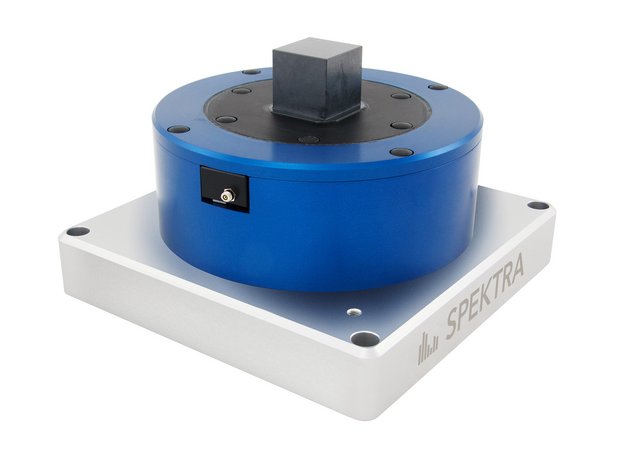
New sensor technologies based on micro-mechanical structures (MEMS) increasingly require mechanical tests in the frequency range beyond 20 kHz. In this high frequency range, the trick is to stimulate the DUT with well-defined oscillations without causing uncontrolled vibration and transverse movements by resonance of the exciter. The new SE-11 vibration exciter provides the ability to excite the DUT with very low lateral accelerations to the main axis of motion in the frequency range of 1 kHz…50 kHz.
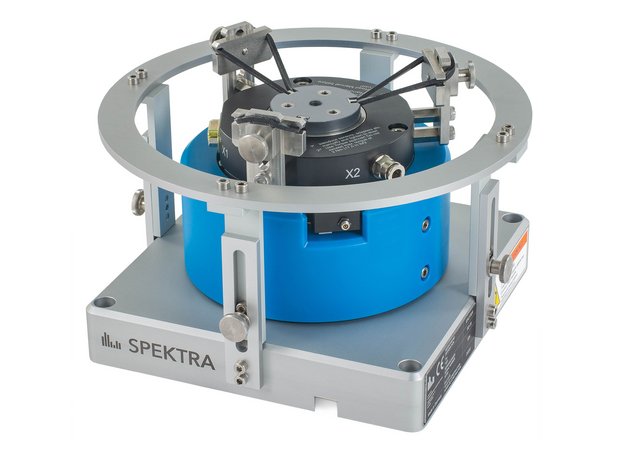
A few years ago, SPEKTRA launched the SE-09, a vibration exciter that offers outstanding performance up to 50 kHz, as the first axial resonance frequency of the vibration head is over 50 kHz. This is thanks to a special technical ceramic that combines low weight with high rigidity. The SE-09 vibration exciter has been developed as a universal vibration exciter that covers the frequency range 5 Hz...50 kHz and allows conventional mounting of the test specimen on the surface of the vibration head, which is perpendicular to the direction of vibration. However, if the test specimen was to be excited in other orientations, an adapter was required that allowed it to be mounted in different orientations.
The disadvantage of such adapters, however, is that they cannot be designed so rigidly that unwanted vibration modes do not occur at frequencies below 10 kHz, which no longer allow precise excitation of the test specimen.
more about the SE-09
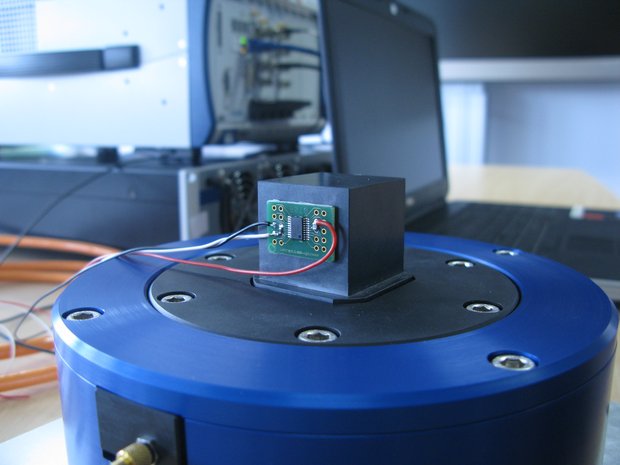
The SE-11 solves this problem elegantly by designing the vibrating head in a way that the samples may be attached to different surfaces, which are either positioned transversely to the vibration direction or in the vibration direction. Thus, DUTs can be stimulated in virtually any orientation. Measurements with laser vibrometers have proven that unwanted transverse vibrations remain less than 5 % in the main axis for vibration up to 50 kHz. This is achieved firstly by the stiff ceramic oscillating head and on the other hand by a special polymer bearing. The SE-11 is complemented by an internal accelerometer that has a continuous transfer function in the frequency range up to 50 kHz. It also reacts insensitively to heat or magnetic fields, making it an ideal reference sensor for the measurement of the excited oscillations.
Update: This product was replaced by the SE-21 in 2024.


