


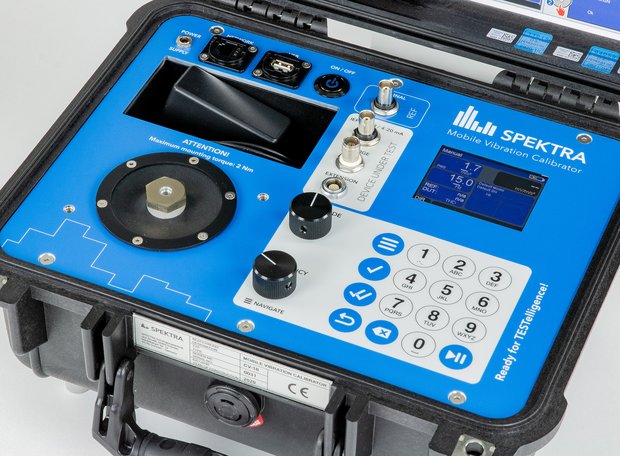
For almost two years, the CV-10 has been the go-to solution for calibrating vibration sensors on-site at machines and test stands. This compact device was designed from the outset as a portable calibration system that can easily adapt to new tasks thanks to its wide range of interfaces and powerful hardware. Firmware version 1.4 implements several new functions that facilitate sensor calibration, particularly in the machine monitoring sector.
CV-10 owners can install the new firmware themselves in a few minutes using the built-in update function.
New functions that make operation even easier
We focused on improving the vibration controller in the CV-10, which is responsible for precisely adjusting the vibration. By optimizing the controller, we reduced the time it takes to adjust the frequency and amplitude of the vibration after entering a target value by up to 25%. This improvement is particularly noticeable during automatic calibrations at medium to high frequencies, as measurement times are greatly reduced.
Many customers requested a lower cut-off frequency, so we reduced the CV-10's from 7 Hz to 5 Hz. In addition to the controller, we have further improved the user interface. It has now become clearer. We have also improved the functions for managing stored data.

Extended range of functions at a glance
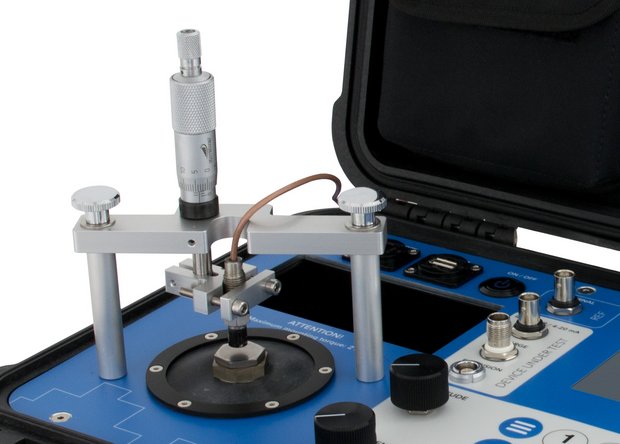
Calibration of proximity probes - With the new firmware, the long-awaited functions for calibrating proximity probes have now also been implemented.
Find out more about the CV-10 Prox
First of all, the target values for the oscillation amplitude can now be specified in µm or mil. The calibrations (frequency points) can be performed either manually or automatically (table of default values).
Calibration of vibration sensors with 4 ... 20 mA output - The already integrated signal conditioner for sensors with a 4…20 mA current output is now fully usable. This makes it easy to calibrate a wide range of sensors. Depending on the sensor type, accelerations or vibration velocities can again be specified manually or automatically.
Transfer calibration of the CV-10 - Even a calibration device needs to be calibrated from time to time and readjusted if necessary. To do this, you can send your CV-10 to SPEKTRA, where it will be extensively checked and calibrated electrically and mechanically. As this is a very time-consuming process for many customers, especially abroad, we have created a simplified calibration and adjustment of the CV-10 using the transfer calibration function. For this purpose, a transfer standard, i.e. a precisely calibrated reference acceleration sensor, is mounted on the CV-10. The transfer calibration now uses the transfer standard as a reference sensor to automatically approach the frequency points and accelerations transferred with a table.
Thanks to this function, the CV-10 can be regularly and reliably recalibrated even under the toughest operating conditions, where slight changes of the device over time cannot always be avoided.

Author:
Audrey Stein
Business Development / Marketing Lead SPEKTRA
Stay up to date and subscribe to our newsletter.


