


GNSS-based navigation is indispensable today. Accurate determination of position and speed would be unthinkable without GNSS, IMU or INS devices. Calibration is essential to ensure you can trust the output values.
“GPS signals take just milliseconds to reach us from space. But until now, customers had to wait several weeks for their system if it needed to be calibrated” says Steven Kallet, Sales Engineer Automotive Services. In this interview, he explains the technical details, the calibration solutions SPEKTRA offers and what customers need to keep in mind.

Let’s start by clarifying what the terms GPS and GNSS mean.
“GNSS (Global Navigation Satellite System) is the umbrella term for all global satellite navigation systems; GPS (Global Positioning System) is the American satellite navigation system. GPS, Galileo, GLONASS and Beidou all fall under the term ‘GNSS.’ Modern measurement systems typically use several of these systems simultaneously to increase accuracy and availability.”
And what is an IMU?
“An IMU (Inertial Measurement Unit) consists of acceleration and angular rate sensors (gyroscopes). It measures the vehicle’s linear acceleration and angular rates. Unlike GNSS, an IMU operates completely independently of satellite signals.”
How does this become an INS system?
“An INS (Inertial Navigation System) combines the measurement data from an IMU with the measurement data from a GNSS module. Through sensor fusion, position, velocity and orientation can be reliably determined even when satellite signals are temporarily disrupted or unavailable, such as in tunnels or urban canyons.”

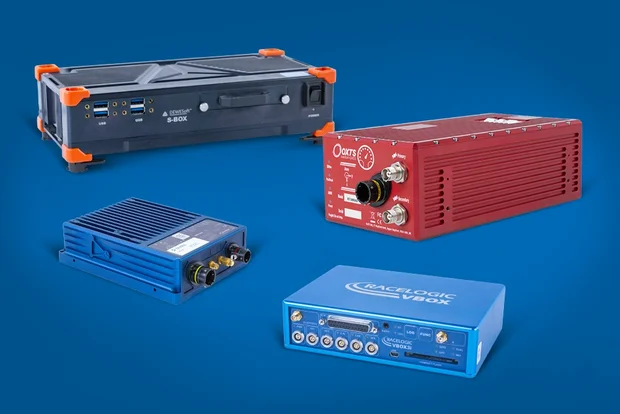
What types of equipment can SPEKTRA calibrate in its laboratory?
“We calibrate GNSS/GPS, IMU and INS systems that measure speed, position, acceleration, heading angle or rotation rate. This includes, among others, data loggers, vehicle dynamics measurement systems, ADAS measurement systems, speed measurement devices and reference systems for vehicle testing.”
What should customers keep in mind before a calibration?
“Access to the measurement system’s raw velocity data is required. Ideally, the software should be provided as well. For some proprietary systems, a technical feasibility assessment may be required in advance. We are, of course, happy to advise our customers on this when they inquire.”
Which IMU/INS calibrations does SPEKTRA offer and what are the differences?
“SPEKTRA offers both static and dynamic calibrations for IMU and INS systems. In a static calibration, defined, stationary test conditions are used to determine the offset, sensitivity or orientation of the sensors, for example. Dynamic calibrations, on the other hand, are performed under defined motion conditions. Accelerations and angular rates are generated using vibration and rotation exciters to verify the sensors' behavior under realistic operating conditions. Depending on the system and application, both methods can be used individually or in combination. Additionally, we can perform customized tests tailored to specific customer needs.”
Is there traceability in this area?
“Yes, the calibrations are traceable to national and international standards. The reference systems and simulators used have documented metrological traceability. While a direct PTB* calibration for GPS velocity does not exist, traceability is ensured through the reference standards and calibration chains used.”
*PTB = ‘Physikalisch-Technische Bundesanstalt’ is the national metrology institute of Germany and the second-largest metrology institute in the world.
Who are potential customers and which industries might be interested in this?
“Our customers include automotive manufacturers and suppliers, as well as testing organizations, development service providers, test track operators, universities and manufacturers of GNSS and INS systems. Traceable calibration is essential wherever precise motion data is required.”
Why is SPEKTRA considered an expert when it comes to calibration services?
“SPEKTRA offers DAkkS-accredited calibrations in accordance with ISO/IEC 17025, thereby ensuring reliable, traceable and internationally recognized results. The reference systems used are metrologically traceable and form the basis for very good measurement uncertainty as low as 0.3%. In addition, SPEKTRA possesses extensive expertise in the fields of GNSS, IMU and INS and combines this expertise with many years of experience in the areas of vehicle dynamics, safety systems and ADAS applications. In addition to standardized calibration services, we also develop customized calibration solutions for client-specific requirements.”
Are there regulations that require calibration?
“There is no direct legal requirement for calibration in many applications. However, quality management systems such as ISO 9001, IATF 16949 or accredited testing processes in accordance with ISO/IEC 17025 require evidence of traceable measurements. In these cases, regular calibration of the measuring equipment in use is required. Having your equipment calibrated regularly lays the foundation for reliable and traceable measurement results.”
Which standards does SPEKTRA use for calibration?
“Depending on the measured quantity and system, calibration is based on different normative and technical principles. GNSS-based velocity measurement is performed according to an accredited internal calibration procedure based on a GNSS simulation. For the calibration of inertial measured quantities such as acceleration and angular rate, comparison methods in accordance with the ISO 16063 series are used. The accredited scope of services is based, among other things, on the requirements of Verkehrsblatt No. 156 (Issue 21/2018). In addition, recognized metrological procedures and, where necessary, manufacturer specifications are taken into account.”
INFO
DAkkS-accredited calibration according to ISO/IEC 17025
- calibration of GPS/GNSS, IMU and INS systems
- for speed, position, acceleration, angular rate and heading angle measurements
- measurement uncertainty up to 0.3%
- metrologically traceable reference systems
- calibration based on GNSS simulation and motion simulation

Why have customers had to go without their devices for so long until now?
“Many users previously had to send their devices abroad. Transportation, customs clearance and scheduling alone often resulted in downtime lasting several weeks. This can cause significant delays, especially with development projects or with test vehicles, which in turn leads to additional costs.”
How can SPEKTRA help minimize downtime for its customers?
“Thanks to our calibration facility in Germany, optimized calibration processes and efficient order scheduling, we achieve short turnaround times. This significantly reduces transportation and delivery times. Standard calibrations are completed within a few business days. For particularly time-sensitive applications, we offer express calibration starting at 48 hours.”
How much does a calibration cost?
“The price varies depending on the system type, scope of measurement, interface accessibility, and individual testing requirements, if applicable. We prepare a customized quote for each customer and offer comprehensive consultation.”
Author:
Audrey Stein
Business Development / Marketing Lead SPEKTRA
Stay up to date and subscribe to our newsletter.


